Showing posts with label Fruits and Vegetables. Show all posts

Saturday, September 10, 2011

The Artichoke - An Edible Flower Bud

That's right. The artichoke, also called globe artichoke,  is the flower bud of a type of thistle.  The perennial thistle cultivar that produces artichokes originated in southern Europe and spread throughout the Mediterranean area. The origins of the ancestors of this cultivar are unknown, but it is believed to have been northern Africa.  Arab horticulturists produced the cultivar from the wild species, and is documented in the Mediterranean area as early as the 9th century in Naples.

Artichokes are a very healthy vegetable. They are full of antioxidants, help lower cholesterol and artichoke leaf extract has been shown to reduce the symptoms of  Irritable Bowel Syndrome.

World artichoke production is centered in the Mediterranean area. the main producers are Spain, Italy and France. Almost 100% of commercial artichoke growing done in the United States is done in California, with the town of Castroville, CA.  proclaiming itself as "The Artichoke Center Of The World".

Artichokes are easy to prepare. Pick ones that are green and firm, with very little or no brown color. Trim the ends of the leaves to remove any thorns, and cut the stem so it is about one inch long. Steam them for 20-45 minutes according to size. The larger ones will take longer. Don't cover the steamer when you cook them, as this will allow certain oils to escape and prevent the artichoke from turning brown. Also put a sliced up lemon in the steaming water, a few cloves of crushed garlic, and a bay leaf. This will add flavor and help retain the green color.
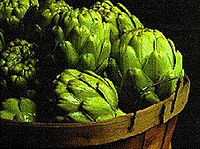
To eat a cooked artichoke, remove the leaves one at a time and dip the large end in lemon butter, mayonnaise, or any other dip you prefer. Drag the end of the leaf over your teeth to remove the fleshy end of it, and move on to the next leaf. Once you get the large leaves eaten and are down to the smaller leaves and 'choke', remove all the leaves and scrape out the choke with a spoon.  What you have left is the 'heart' of the choke and is the best part. Cut into pieces, dip and enjoy!

Wednesday, June 15, 2011

Snow Peas


Snow peas are an edible pea pod that are a staple of Chinese cooking, and can be found in many produce sections and markets.  Don't confuse them with sugar snap peas. Snow peas are smaller and flatter while sugar snap peas are rounder and fatter.


Peas are perhaps one of the oldest cultivated vegetables, as evidence of peas were found at a stone-age lake village archeology site in Switzerland.  The wild variety of peas are believed to have been native to western Asia and eastern Europe.   Peas weren’t really popular in Europe until after 1600. They were thought to be extravagant and were eaten only by royalty.


With their crisp texture, they are perfect for stir-frying as they take only a minute or two to warm through.  They have a unique flavor, slightly sweet with just a hint of bitterness to the larger pods, especially when eaten raw. They can be added to main dish meals or served as a vegetable side, added to soups or served raw in salads.


They are very high in Vitamins A and C and are loaded with iron and potassium. When shopping for them, select pods that are no longer than 3 inches, that have a good color, are firm and have no dark spots on them. To prepare them for cooking, remove both ends by pinching and wash thoroughly and cook them whole.


If you like to garden, try growing your own.  Snow peas are very easy to grow. They need to be planted early in the spring, before the last spring frost as they grow very well in cooler temperatures. They can even handle frost. Just follow the directions on the seed packet, provide them a fence or lattice to climb, and you'll have a good crop of snow peas as a reward.  Keep the pods picked, and the plants will continue to produce for quite awhile. Snow peas are easy to preserve by freezing. Just prepare them as for cooking, but dry them and spread on a single layer on a cookie sheet and put into the freezer. When frozen, put them in a zip lock bag and store in the freezer.


Tuesday, June 7, 2011

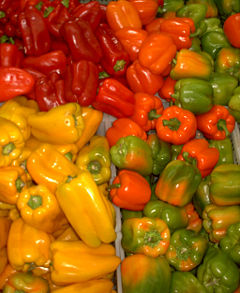
Sweet Peppers - History And Facts

Sweet peppers originated in South America and Mexico. Evidence of them dates as far  back as 5000 BCE. Some facts and history about the Jalapeno pepper's mild cousin:
  • Sweet peppers are in the same family as eggplant, potatoes, tomatoes, and deadly nightshade, a toxic plant. 
  • The first explorers of South America were from Portugal and Spain, and they carried sweet peppers to their native lands and around the world. 
  • The most common type of sweet pepper are bell peppers, so named because of their bell-like shape. They all can be eaten green, or for a sweeter taste they can be allowed to ripen.  Depending on the variety, fully ripened bell peppers can be red, yellow, brown, black, or orange.
  • The other type of sweet peppers come in a variety of colors and are shaped more like a banana.  
  • Bell peppers are not hot, even if you plant a bell pepper next to a hot pepper plant, the bell pepper will not cross with the hot pepper. But banana peppers can cross with hot peppers if the plants are too close together. 
  • Sweet peppers are very high in Vitamins C and A. These two antioxidants work together to break up free radicals which cause damage to cells.  Including sweet peppers in your diet can help prevent or reduce asthma symptoms, arthritis, diabetes-caused nerve damage, and other ailments. 
  • Peppers were named by Christopher Columbus, namely the hot varieties because they reminded Columbus of the heat of black peppercorns.

Tuesday, February 15, 2011

Mushrooms - Plants Or Animals?

All mushrooms belong to the family of fungi, which is neither plant or animal. After continuing research there is evidence that fungi may be more closely related to animals than plants. The fungi family includes over 200,000 identified species with possibly hundreds of thousands more that have not been identified. From the tiniest microfungi such as bread mold and yeast to what is believed to be the largest living thing on earth, a Honey Mushroom that lives in the Blue Mountains of eastern Oregon that is estimated to cover over 2,200 acres and be at least 2,400 years old, the earth teems with fungi! There are many varieties used for cooking, from the common and inexpensive button mushroom to the very expensive (thousands of dollars a pound) for white truffles.

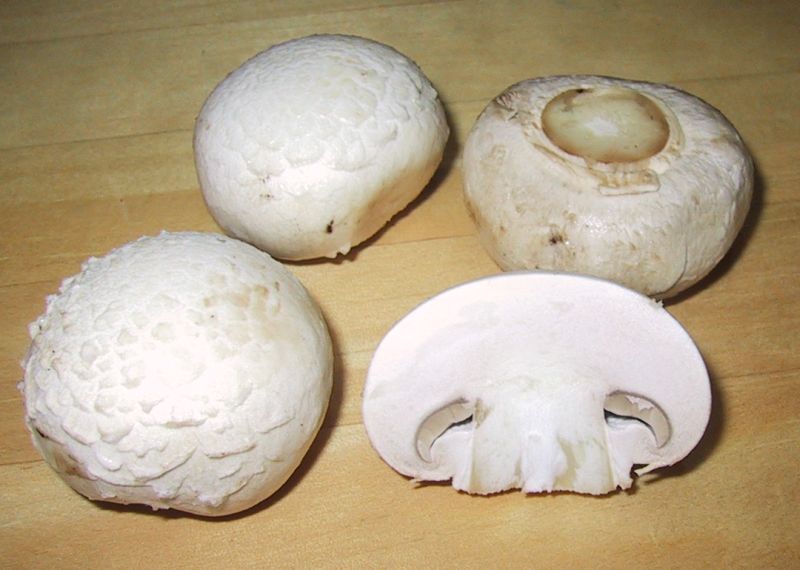
The most widely cultivated, harvested and purchased mushroom in the world is the white or button mushroom. It is low in Saturated Fat and Sodium, and very low in Cholesterol and a good source of Dietary Fiber, Protein, Vitamin C, Folate, Iron, Zinc and Manganese, and a good source of Vitamin D and many other nutrients and vitamins.

Button mushroom flavor is mild, and they tend to take on the flavor of  foods they are cooked with. They are easy to use either whole or sliced. There is a school of thought that since these mushrooms tend to absorb liquids that they should not be washed, but gently brushed off before cooking. Personally, I see no harm in washing mushrooms especially when it is remembered that they are grown in horse manure (albeit sterilized and composted). As long as they are rinsed and dried without allowing them to soak in water, there should be no problem.

The next most widely used mushroom is the Crimini, or Italian Brown mushroom.  When these mushroom grow larger they are called Portabella mushrooms.  They are actually the original mushroom that the button mushroom was derived from. The white color was developed because it was thought to be more eye-appealing. Crimini mushrooms tend to be a little more dense in texture and have a deeper flavor than button mushrooms. 

There are some basic guidelines to using these mushrooms and many other mushrooms.  If you are using them fresh, do not wash them or slice them until ready to incorporate them into the dish. If you are using canned mushrooms, be sure to drain them well.  If you are pan-frying them by themselves they will tend to soak up some of the oil so be sure to add a little more when needed. The difference in taste between mushrooms browned and caramelized with oil and/or butter and those that don't get caramelized and brown is like night and day.  Potabella caps can be pan-fried and used and eaten as a hamburger with all the trimmings for a veggie burger. They can also be stuffed with a variety of stuffings. 

There are many other varieties of mushrooms, fresh and canned, available in supermarkets. But these two basic kinds of mushrooms can take you a long way into learning how to use and appreciate this very unique, versatile and nutritious fungi.

Friday, October 8, 2010

Kale And Chicken Stir Fry

Kale is in the same family of vegetables as cabbage, broccoli, brussel sprouts, cauliflower, and a whole lot more too numerous to mention. They are all classified as cruciferous vegetables .

There are numerous benefits derived from eating these kinds of vegetables. Preliminary studies have shown that cruciferous vegetables can lessen the chances of developing cancer and diabetes, just two examples of the benefits of these vegetables.

All of them are also high in many essential vitamins and minerals, with Kale being one of the highest in concentrations of beta carotene, vitamin K, vitamin C, lutein and calcium. To reap the benefits of all the goodness within these vegetables it is best to eat them raw. When cooking, it is best to steam or stir fry them.

Healthy is one thing, but how do they taste? For those that find some of these vegetables too strong in flavor, stir frying is an excellent way to offset any bold flavor with other flavors.

To prep Kale, wash thoroughly as the crinkly leaves of some varieties can hold dirt and grit. Make sure you remove the leafy part all the way up both sides of the stem. The stem is too tough to eat on its own, but it can be used to make a vegetable stock .


Kale And Chicken Stir Fry

  • 2 skinless boneless chicken breasts
  • 1 bunch of Kale
  • 8 ounces of button mushrooms, sliced
  • 1 carrot, sliced on an angle
  • 1 celery rib, diced
  • 1 small onion, diced
  • 4 green onions cut in 1 inch pieces
  • 1 can baby corn
  • 2 TBSP peanut oil
  • 1 tsp sherry
  • 1 TBSP corn starch
  • 1 TBSP oyster sauce
  • 1 TBSP soy sauce
  • 1/2 tsp sesame oil
Clean and destem Kale and tear into pieces. Prep all other vegetables and cut up chicken into bite sized pieces. Combine oyster sauce, soy sauce, corn starch and sesame oil in a small bowl. Add enough cold water to dissolve the corn starch.

Heat up wok. When hot, add peanut oil. Add chicken and diced onion. Stir fry for a minute or two, then add sherry. Stir fry until meat is cooked through. Remove chicken and onions and set aside.

Add more oil to wok if needed. Add mushrooms, carrot, celery and green onions. Stir fry for one minute. Add Kale and baby corn. Stir fry until Kale wilts, then add chicken back into wok. Stir fry for a minute while thoroughly combining all ingredients in the wok. Stir the corn starch mixture and then add to wok. Continue stir frying until mixture thickens. Serve on rice or oriental noodles.

Monday, September 27, 2010

The Tomato - From The New World

Some history and facts about tomatoes:

  • Tomatoes are in the same botanical family as tobacco, peppers, potatoes, eggplant and the poisonous plant deadly nightshade.
  • Tomatoes are thought to have originated in South America and Mexico. These wild tomatoes were the size of the modern day cherry tomatoes.
  • The Mayan and other peoples of Central America and Mexico were the first people to domesticate the tomato.
  • Spanish explorers took the tomato from South America and Mexico and introduced it to the Caribbean area and the Philippines. From these areas the tomato moved to the Mediterranean and southeast Asia regions.
  • The tomato is a relatively recent cooking ingredient in Italy. The earliest record of tomato use in Italy was in a recipe in a 17th century cookbook.
  • The tomato was first grown in England in the last decade of the 16th century. It was considered poisonous and used only as a table decoration until the early 1700's.
  • Tomatoes were also considered poisonous in early America, even though Thomas Jefferson ate them in Paris, brought back seeds and grew them in his garden.
  • Tomatoes are a very healthy food. Studies have shown that a diet including tomatoes can reduce the risk of heart problems, reduce the risk of prostate disease, good for pancreatic health, colon health, antioxidant and cancer prevention qualities.
  • There were over 130 million tons of tomatoes produced in 2005. China is the largest producer of tomatoes and accounts for 25% of total world production.
  • The tomato is technically a fruit, more specifically a berry. It is used more as a vegetable because it does not have the sweet flavor usually associated with fruits.
  • The record for the heaviest tomato grown is 7 ponds, 12 ounces grown in Oklahoma in 1986.
  • The largest tomato plant on record is one that reached 65 feet in length, grown in England in 2000.
  • The fruit of the tomato comes in a rainbow of colors. Red, pink, green, purple, yellow, orange, even a white tomato.
  • The Campbell Soup Company introduced their canned Tomato Soup in 1897 and it has been one of their biggest sellers ever since.

Saturday, September 25, 2010

Garlic - The Left Footprint Of Satan

Some facts and folklore about garlic:
  • Garlic is a member of the same family as the onion, leek and shallot.
  • The name 'garlic' comes from an Old English word that means 'spear leek'.
  • Garlic is thought to have originated in southeast Asia. It has been used in culinary and medicinal applications for at least 6,000 years.
  • China is by far the largest producer of garlic. In 2005 China produced 23 billion pounds of garlic, 75% of the world's total production.
  • There is an ancient Christian myth that says when Satan left the garden of Eden, garlic sprouted out of his left footprint.
  • Some have said that if a clove of garlic is crushed and rubbed on the sole of your foot that you will experience the taste of garlic on your tongue after a half hour or so.
  • Garlic is a natural blood thinner and massive consumption of it can lead to bleeding disorders.
  • Garlic as well as onions can be toxic to dogs and cats.
  • Garlic contains natural antibiotic and anti-fungal compounds. These compounds are released from the clove after it is crushed, but quickly break down in contact with air.
  • The sharp, hot flavor of raw garlic is caused by the breaking down of the cellular walls when garlic is chopped, crushed or minced. This releases various sulfur compounds which account for the sharp flavor. These compounds are removed when garlic is cooked, thus causing the garlic to mellow in flavor.
  • 'Garlic breath' that occurs after eating garlic is not only caused by residue of the garlic left in the mouth. It is the result of the digestion of the garlic and the odor is exhaled through the lungs. Any attempts at sweetening garlic breath will not actually stop it, only mask it.
  • In the United States, garlic was found only in ethnic dishes until the 1930's. Slang terms for garlic in the early 20th century were Bronx Vanilla and Italian Perfume.
  • Gangsters in the first half of the 20th century would rub crushed garlic cloves onto bullets they loaded into their guns. If anyone that was shot survived, they were likely to develop a serious infection from a garlic-rubbed bullet.
  • The smaller the piece of garlic, the stronger the flavor. So when you use it, the smaller you mince it the more you'll taste it.
  • Because of its odor, garlic is sometimes referred to as The Stinking Rose.

Friday, September 24, 2010

The Marvelous Onion - Facts And Folklore

Onions have been valued for thousands of years for culinary, medicinal and other uses. Some facts and folklore about the onion.

  • The common onion is part of the Allium or lily plant family, which includes garlic, chives, leeks and shallots.
  • The onion gets its name from the Latin word uniowhich means 'one' or 'single', as onions are different than garlic, which produces many small bulbs while the onion produces only one.
  • Traces of onions have been found in Bronze Age settlements dating back to 5000 B.C.E.
  • Actual cultivation of onions by man is believed to have begun 4000 years ago in ancient Egypt.
  • Alexander the Great fed his army onions with the belief that if they ate strong foods, they themselves would become stronger.
  • Onions have strong antiseptic qualities, and their juice has been used for cleansing and healing wounds for centuries, all the way up to the American Civil War.
  • When The Plague infected Europe, some believed it was caused by evil spirits. Some would wear strings of onions around their necks to try and protect themselves.
  • Onions have also been used for other varieties of ailments through the centuries. In ancient India they were used as a diuretic, in China they were used for many things like liver disease, constipation and wound healing. In Colonial America eating a raw wild onion was thought to cure measles.
  • There is medical research that proves onions are indeed a healthy vegetable. They can lower blood glucose, lower blood pressure, lower overall cholesterol, dissolve blood clots and help prevent cancer.
  • There are two general categories of onions. Fresh spring/summer onions and storage onions. Fresh onions can be any color, some have their green stems attached. They are generally milder than storage onions. Storage onions can be red, yellow or white. They can range in flavor from mild to really strong, but most storage onions sweeten up and become mild when cooked.
  • Everybody who has ever had to cut up a lot of strong onions knows what happens. It is literally a job that makes all of us cry. That is because onions contain sulfur, and when you cut the onion sulfur is released into the air. This air-borne sulfur reacts with the moisture in your eyes and creates a mild form of sulfuric acid. Your eyes tear up to flush this substance from your eyes.
  • There are many ways to try and prevent crying while cutting up onions, some methods practical, some not. Some say cut them under water, or put them in the refrigerator an hour before cutting, or don't cut the root end until last. Some have even suggested putting on a tight fitting swimming mask.
My Zimbio